LM358 Pinout
LM358 · DIP-8 / SOIC-8
The LM358 is a dual op-amp in an 8-pin package: two independent amplifiers sharing one pair of supply pins. It is the usual choice for single-supply circuits because its inputs work all the way down to ground.
Checked against the KiCad library and datasheet on
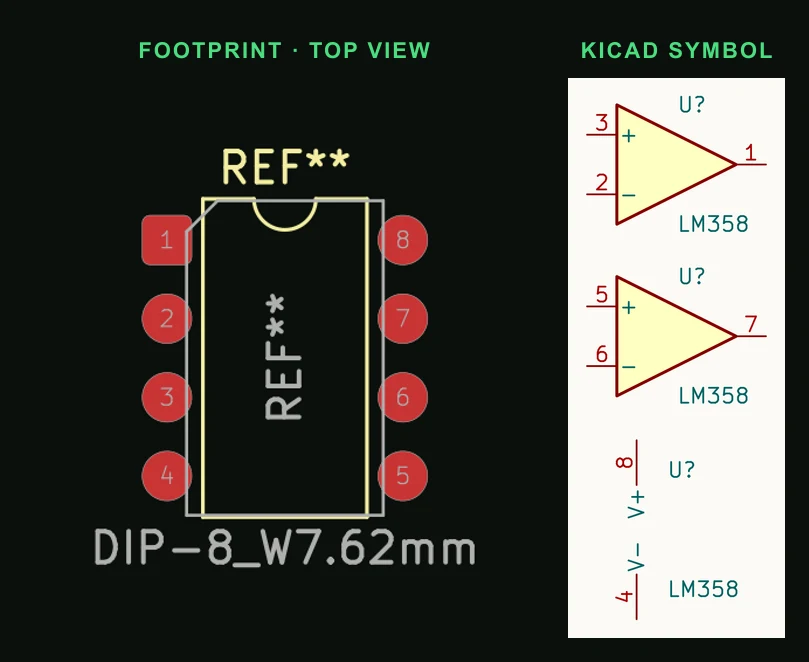
Pin by pin
| Pin | Name | Function |
|---|---|---|
| 1 | OUT A | Output of amplifier A |
| 2 | IN A− | Inverting input of amplifier A |
| 3 | IN A+ | Non-inverting input of amplifier A |
| 4 | GND / V− | Ground on a single supply, the negative rail on a split supply |
| 5 | IN B+ | Non-inverting input of amplifier B |
| 6 | IN B− | Inverting input of amplifier B |
| 7 | OUT B | Output of amplifier B |
| 8 | V+ | Supply: 3 V to 32 V single, or ±1.5 V to ±16 V split |
Things that catch people out
- The inputs work from ground up to about 1.5 V below V+. A signal closer to V+ than that is outside the input range and the output stops following it.
- The output is not rail-to-rail either: with a load it tops out roughly 1.5 to 2 V below V+.
- With an AC-coupled load, TI recommends a resistor from the output to ground: it biases the output stage and prevents crossover distortion. DC-coupled loads do not need it.
- An unused half still needs wiring. Connect it as a follower (output to its inverting input) with the non-inverting input at a voltage inside the input range; do not leave its inputs floating.
Putting the LM358 on a PCB
- One 100 nF capacitor from pin 8 to pin 4, at the package, serves both amplifiers.
- Pin 4 is ground on a single supply but the negative rail on a split supply. Check which your schematic means before the ground pour reaches it.
- Place each amplifier's feedback parts next to its own pins (2 for A, 6 for B) so the two inverting nodes stay short and apart.
Common questions
- Which other op-amps share the LM358 pinout?
- Most 8-pin dual op-amps use the same industry-standard pinout: LM2904, TL072, NE5532, MCP6002 and LM1458 among them. Same pins does not mean drop-in: a TL072's inputs do not work near its negative rail, and an MCP6002 is limited to 6 V supplies, so check the supply and input range for your circuit.
- Can the LM358 work from a single 5 V supply?
- Yes, that is what it is designed for. Inputs work from 0 V to about 3.5 V on a 5 V supply, and the output swings from near 0 V to roughly 3.5 V.
- What is the difference between the LM358 and LM324?
- The same amplifier, two per package in the LM358 and four in the 14-pin LM324. The pin numbers differ: on the LM324, V+ is pin 4 and GND is pin 11.
Building a single-supply amplifier or comparator around the LM358? Describe it, say a microphone preamp with a gain of 50 on 5 V, and get the schematic and a routed board.
Design an LM358 board →Sources
- Texas Instruments LM358 datasheet
- KiCad 9 libraries: symbol Amplifier_Operational:LM358, footprint Package_DIP:DIP-8_W7.62mm (CC-BY-SA 4.0).