Mil to mm Converter for PCB Specs
Convert mils to millimetres one value at a time or a whole fab capability sheet at once, ready to type into metric design rules.
- Exact
- 0.0254 mm
- Safe rule value
- 0.03 mm
- Micrometres
- 25.4 µm
- Inches
- 0.001 in
Convert a whole fab capability sheet
Type the minimums from your fab’s sheet in mils. The right-hand column is what to enter as a design rule in millimetres: rounded up, so a converted minimum is never tighter than the fab allows. The starting numbers are examples, not any fab’s real limits.
| Rule | Mils | Exact mm | Enter as |
|---|---|---|---|
| 0.127 | 0.13 mm | ||
| 0.127 | 0.13 mm | ||
| 0.3048 | 0.31 mm | ||
| 0.127 | 0.13 mm | ||
| 0.254 | 0.26 mm | ||
| 0.1524 | 0.16 mm |
1 mil = 0.0254 mm exactly (a mil is 0.001 inch, also called a thou). mm = mil × 0.0254; mil = mm ÷ 0.0254.
When the number is a fabrication minimum (trace, gap, drill, ring), the metric rule you enter must not be smaller than the fab’s figure. This page rounds those up to the next 0.01 mm; plain conversions are shown unrounded.
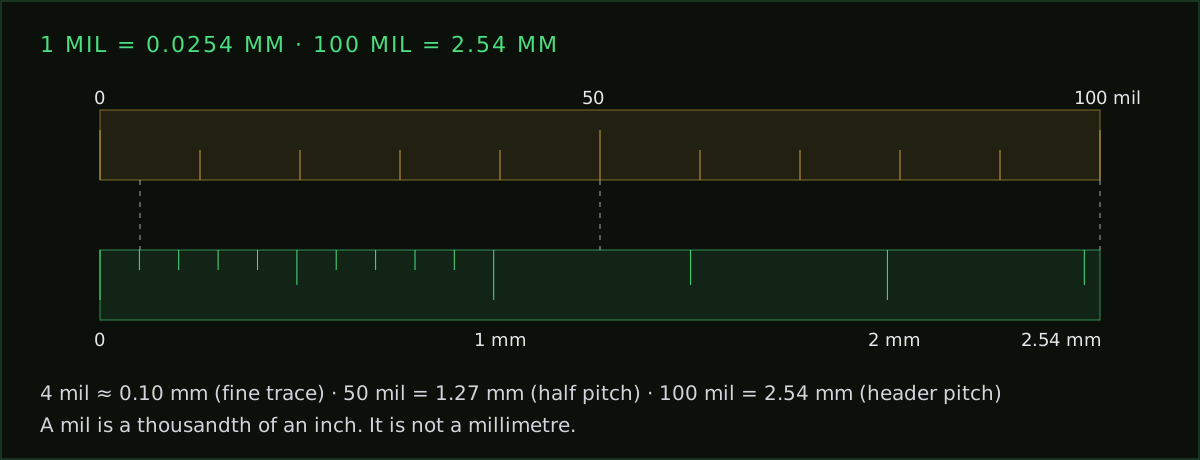
Mil to mm table for PCB values
| Mils | Millimetres | Where you meet it |
|---|---|---|
| 3 mil | 0.0762 mm | Trace/space at the edge of what most fabs build |
| 4 mil | 0.1016 mm | Fine-pitch escape traces |
| 5 mil | 0.127 mm | A common low-cost minimum trace and gap |
| 6 mil | 0.1524 mm | Comfortable minimum for prototypes |
| 8 mil | 0.2032 mm | Relaxed signal trace |
| 10 mil | 0.254 mm | Default signal trace in many libraries |
| 12 mil | 0.3048 mm | Small via drill |
| 20 mil | 0.508 mm | Light power trace |
| 31.5 mil | 0.80 mm | Thin board (0.8 mm) |
| 50 mil | 1.27 mm | Half of a 0.1 in pitch; SOIC pin pitch |
| 62 mil | 1.575 mm | The classic 0.062 in board, sold as 1.6 mm |
| 100 mil | 2.54 mm | Standard pin-header pitch |
Why you still need mils in a metric tool
Most PCB manufacturing grew up in the United States, so capability sheets, IPC tables and a lot of older footprint libraries still quote trace width, spacing, drill and annular ring in mils. Your design tool, your component datasheets and your mechanical drawing are probably metric. Every board therefore crosses the unit line at least once, usually when you copy the fab’s limits into your design rules. That copy is where errors creep in.
Round minimums up, not to the nearest
A 5 mil minimum is 0.127 mm. Round that to the nearest hundredth and you get 0.13 mm, which is fine. But a 3.5 mil minimum is 0.0889 mm, and rounding to the nearest gives 0.09 mm while rounding the wrong way gives 0.08 mm, which is finer than the fab can build. The board will pass your own design-rule check and fail theirs. The rule is simple: a minimum only ever rounds up. A maximum (for example the largest drill a fab stocks) only ever rounds down.
Putting the numbers into your design rules
Use the sheet translator above, then copy the right-hand column into your board’s constraints: minimum track width, minimum clearance, minimum drill, minimum annular ring and copper-to-edge clearance. In KiCad that is Board Setup, Design Rules, Constraints, and its dimension fields also accept a unit suffix, so typing 5mil into a millimetre field converts it for you. Whatever tool you use, run the design-rule check after changing units: a rule entered in the wrong unit is off by a factor of about 39, and the check will happily pass a board that no fab can build.
Mil, micron, thou: the mix-ups
A mil is a thousandth of an inch, 25.4 micrometres. It is not a millimetre and not a micron. In coating and plating specs you will also see thickness in micrometres or micro-inches; 1 mil is 25.4 µm and 1000 µin. Copper weight is a different unit again: 1 oz/ft² is about 1.37 mil (34.8 µm) of copper. Going the other way, from millimetres to mils, use the mm to mil converter.
Frequently asked
- How many mm is 1 mil?
- 1 mil is exactly 0.0254 mm. A mil is one thousandth of an inch.
- What is 5 mil in mm?
- 5 mil is 0.127 mm. As a design-rule minimum, enter 0.13 mm so the rule is never finer than the fab's figure.
- What is 10 mil in mm?
- 10 mil is 0.254 mm, a common default signal-trace width.
- Is a mil the same as a micron?
- No. A mil is 25.4 micrometres (microns). 1 micron is about 0.039 mil.
- How thick is a 62 mil PCB in mm?
- 62 mil (0.062 in) is 1.575 mm. Fabs sell it as the standard 1.6 mm board.
Once the fab's limits are in millimetres, they still have to be enforced. PCBEditor routes against the trace, gap and drill limits of the fab you pick and flags anything below them.
Design a board to these rules →Related free tools
- mm to mil Converter (PCB)Convert millimetres to mils and back, with the trace widths and clearances the numbers actually map to.
- PCB Trace Spacing vs Voltage Calculator (IPC-2221)Minimum spacing between conductors at a given voltage from IPC-2221B Table 6-1, for inner layers, bare outer layers and coated outer layers.
- Via & Through-Hole Pad Size CalculatorPad diameter, drill size and aspect ratio for vias and through-hole leads, including the diagonal rule for square header pins.